I'm a Quality Manager. I Checked Xometry's ISO 9001 and AS9100 Certifications—Here's What Passed My Inspection.
If you've ever had a supplier tell you a part is “within industry standard” and then watched it fail your incoming inspection, you know why quality people keep their enthusiasm on a short leash. I'm a quality and compliance manager at a medical device contract manufacturer. I review roughly 200 unique part numbers each year, and since I implemented our supplier verification protocol in 2022, I have learned to check the certificate before I believe the brochure.
The project that brought Xometry onto my desk was a 50,000-unit plastic housing for a portable diagnostic device. Our current molder was quoting 16 weeks, and the engineering manager wanted a faster bridge. He forwarded the news with the subject “Xometry Receives ISO 9001 & AS9100 Certifications.” Then he asked, “Can you qualify them for Xometry's injection molding services?”
My first answer was not polite. I said that a wall certificate doesn't make good parts. And I believed it. In my experience, a real injection molding supplier needs process engineers, mold maintenance logs, and a shipping dock where someone knows your name. A digital marketplace with an instant quoting engine? I did not expect much.
Before I rejected the idea, I did what a quality manager should do: I looked up the certificate. The first surprise: the certificate checked out. The quality management system registration covered ISO 9001:2015 and AS9100D under an accredited registrar. AS9100D is not the same as ISO 9001. It adds configuration management, traceability, and risk-based thinking to satisfy aerospace and defense customers. For a medical device company with aspirations in more regulated markets, that extra layer matters. It would be easier to audit one platform that connects certified production partners than to audit 40 small shops individually.
The FDM vs. MJF 3D printing debate
Our program asked for two kinds of prototypes while the production mold was being built: one set in FDM and one set in MJF. A friend once asked me which “best 3D printers for children” list I recommended. I said the printer is less important than the supervision. The same applies here. FDM and MJF both produce useful parts, but they fail differently. FDM can show layer adhesion limits; MJF can show a grainy surface that looks rough next to a molded part. Neither failure made Xometry a bad supplier. Both failures told us which process belonged in which part of the program.
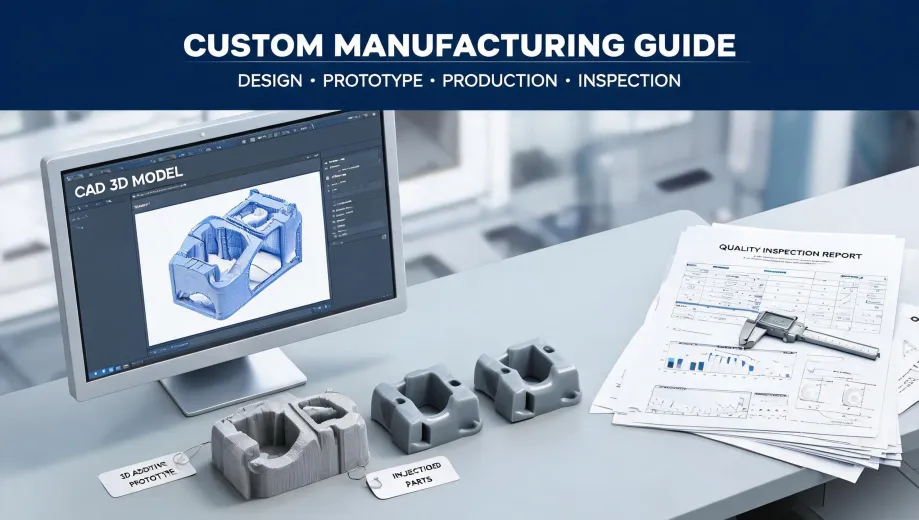
The FDM parts were good for snap-fit testing and quick layout checks. The MJF parts gave us better detail on small vent openings and internal features. The MJF surface was not as smooth as an injection molded part, but it was acceptable for an internal component. The important thing was that Xometry's quality documentation treated both processes as manufacturing processes, not as toys. Every sample lot had a material certificate, a process identifier, and a first article inspection report attached to it. That is more than I can say for some traditional shops I've audited.
One sheet metal sub-component came with a setup note that read: “hole opener reamer after laser cutting.” It was there to remove the tiny burr on the inside edge before powder coating. Nothing glamorous, but it told me someone had thought about how the hole would feel to an assembler. I have stopped many shipments for burrs that are technically within tolerance but cause cut gloves and scratched wrists.
The real injection molding test
The production molded housings arrived ahead of schedule. They were packed by cavity number, and every housing carried a date code and lot code. I did not have to call a customer service representative to ask whether the lot was isolated. I scanned the label on the box, and the portal pulled up the material certificate, the machine number, the cavity number, and the CMM data for the critical dimensions.
What stood out to me was not that every part was flawless. They weren't. In the second production lot, our inspection found gate blush on a number of housings near the ejector pin. I rejected them. What impressed me was the response. Xometry's quality portal showed the same lot had already quarantined 63 parts for cosmetic issues, documented the nonconformance, and asked us to confirm the disposition. The shipping count was correct: 2,437 good parts, not 2,500 questionable ones. Most suppliers I've dealt with would have shipped the full count and hoped the blush was not visible.
This is where my original assumption broke. I assumed a digital platform would hide behind a quote engine. Instead, the digital layer made the evidence easier to inspect. Each housing carried a lot code; scanning that code pulled up material cert, machine number, cavity number, and inspection data. I did not need to call three people and wait for a PDF buried in an email thread.
I also measured color against the approved Pantone chip. The housing matched at ΔE 1.2 under D65, inside the commonly used ΔE < 2 tolerance for critical brand colors. The label was printed from a 300 DPI file, which is the minimum for commercial print at final size. These small details may sound picky, but for a device that could sit in a hospital for seven years, consistency matters more than the first article.
To be fair, not everything went perfectly. The first molded samples needed two extra process tweaks for ejector pin witness marks, and one shipment arrived with a slightly short count because of quarantine. But those issues were visible, documented, and resolved through the same system that generated the certificate. In the old model, I would have spent a week on the phone and received a revised paperwork packet by fax.
What I learned
What was best practice in 2020 may not apply in 2025. I spent years qualifying suppliers by driving to their shops, looking at their toolroom, and checking their reference list. That is still a good practice. But it is not the only path. Xometry's ISO 9001 and AS9100 certification got me to the table; the documented process control is what kept me there.
I have mixed feelings about the phrase “digital manufacturing.” On one hand, no platform replaces a skilled machinist or toolmaker. On the other hand, the old way of managing quality—paper certificates, phone calls, guesswork—has not aged well. The best shops have always kept records; the best platforms make those records impossible to lose. That is the evolution I had to accept.
For what it's worth, I still keep a printed copy of the supplier approval in our quality office. The signed pages go by USPS when a customer demands a wet signature. As of January 2025, a one-ounce First-Class Mail letter costs $0.73. Some fundamentals—like signatures and skepticism—do not change. But the manufacturing industry's execution has changed, and a quality manager who ignores that is like an inspector who rejects parts because they arrived in a clean box.