I'm Done Calling Around for Manufacturing Quotes
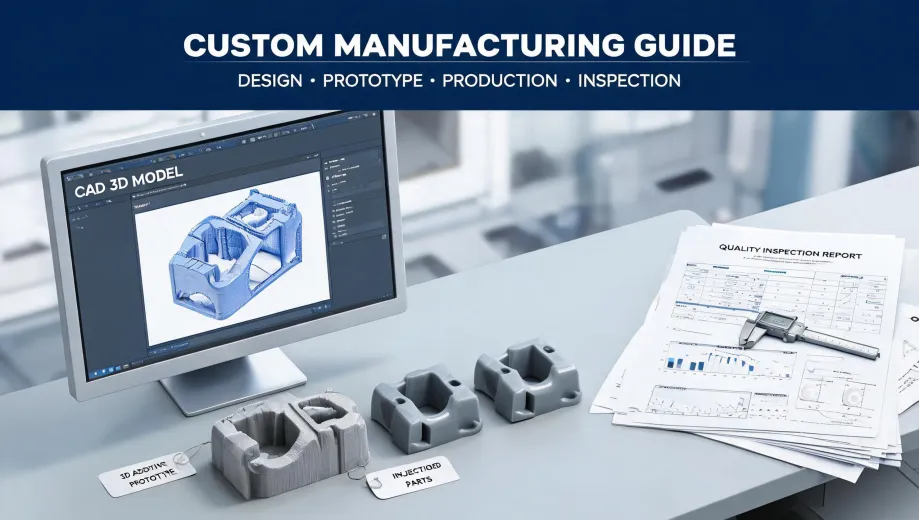
Here's my unpopular opinion, and I'm sticking to it: calling around for manufacturing quotes is a waste of time. Not "sometimes useful." A waste.
I'm the office administrator for a 28-person product development company. I manage all custom part ordering—roughly $180,000 annually across eight vendors. That's everything from CNC-machined brackets and injection-molded enclosures to short-run 3D-printed prototypes and sheet metal covers. I report to both operations and finance, which means I feel every hidden cost twice: once when it shows up on the PO, and again when finance asks me to explain it.
I wasn't always on board with online quoting. When I took over purchasing in 2020, I worked the same way my predecessor did: email three shops, call two more, wait a week for responses. Then came the second round of questions. "What material exactly?" "Do you need this finish?" "Are you sure about that tolerance?" Every clarification pushed the real price further away.
Here's the thing: a quote that changes after you ask the right questions isn't a quote. It's a down payment.
Why Instant Quoting Builds More Trust Than a Handshake
The first time I used Xometry's instant quoting engine, I didn't expect much. One of our engineers had already set up an account and told me to "just upload the STEP file and see what happens." So I did. Within minutes I had a price, a lead time, and—this is the part that hooked me—a clear list of assumptions. Material. Tolerance. Quantity. Finish. Everything itemized before I spent a dollar.
No phone tag. No "send the drawing again, we lost it." No surprises.
That's when I realized something: transparency isn't just a nice-to-have in procurement. It's the foundation of trust. The online printing industry figured this out years ago. You can get instant quotes for 500 business cards, double-sided on 14pt cardstock, and see the full price range before committing—budget tier around $20-35, mid-range $35-60, premium $60-120, based on publicly listed prices as of January 2025. Setup fees that used to be mysterious line items are now either included or listed clearly. That kind of upfront pricing is table stakes now. Custom manufacturing is finally catching up, and Xometry is leading that shift.
Sure, experienced shop owners will tell you "manufacturing is different from printing." And they're right that complexity is higher. But complexity is exactly why transparency matters more, not less. When a part has fourteen critical dimensions and a surface finish requirement, the last thing I need is a vendor who treats quote accuracy as an optional extra.
Nothing Is "Standard" When It Comes to Tolerances
Here's a lesson that cost me real money: "standard tolerances" mean different things at different shops.
I assumed "standard machining tolerance" was a universal default. Didn't verify. Turned out one vendor's standard pass was another vendor's reject grade. The rework ate $2,400 from our department budget and produced the exact kind of conversation with finance that makes procurement people consider a career change.
Here's what I've since learned: in CNC machining, "standard" can mean anywhere from ±0.005 inches to ±0.030 inches depending on the shop. There's an industry standard—ISO 2768—but even that leaves room for interpretation. In 3D printing, tolerances depend on the process; SLA (stereolithography) generally holds tighter dimensions than FDM, but every material behaves differently. If a quote doesn't tell you what tolerance it's based on, you're not comparing quotes. You're just collecting guesses.
Xometry tolerances are documented for every process the platform offers. When the quote engine says "tolerance: standard," you can click through to see what that actually means for CNC machining, injection molding, or 3D printing. Need it tighter? Switch to "precision" and the price updates in real time. No handwaving. No "this tolerance needs extra work" discovery at the end of the project.
I've also learned to ask "what's NOT included?" before asking "what's the price?" That question alone saved me from a $600 surprise plating charge a few years ago. But honestly, I shouldn't have to think to ask. The system should tell me.
The Supplier Side Has More to Offer Than I Expected
I'll admit I was skeptical about "Xometry become a supplier" at first. Sounded like a way to squeeze small machine shops. But from a buyer's perspective, having more vetted capacity on the platform is a direct benefit. My worst purchasing failures came from relying on too few vendors. When one of my long-standing local shops got backed up in 2023, I needed alternatives fast. The network depth saved me.
And the transparency works both ways. Suppliers set their capabilities and lead times on the platform, visible to buyers before we commit. I never hear "let me check the shop floor and get back to you" on Xometry. The information is just... there.
The supplier vetting process matters too. Before a shop can join, they have to demonstrate their capabilities. For me, that's a huge confidence boost. I don't have to maintain a personal Rolodex of shops hoping I picked the right ones. The platform has already done the initial screening, and I can check performance ratings before I order.
Acronyms, Calibration Towers, and Service Level Agreements
Managing purchasing means admitting when you don't understand the engineering side. For the longest time, I asked myself: why do 3D printers print a tower? I mean literally a small stepped tower, every time someone calibrates a filament. Turns out it's a temperature calibration test: each section prints at a different nozzle temperature, so you can see exactly where that filament stops bonding cleanly. The sections printed too hot look blobby and droopy. The sections printed too cold look weak and cracked. The sweet spot in the middle is what you set your profile to. I only know this because I asked one of our engineers instead of pretending it was obvious.
Those little curiosities matter when you specify parts. Last year we needed 3D printing services Buffalo NY for a last-minute customer prototype. A local-only vetting process would've taken a week. Xometry matched us with a nearby shop that delivered in three days. We didn't even have to drive across town to pick it up.
Another acronym I had to learn: VMC. Vertical machining center. When our team asked for "VMC on AWS SLA," I thought they were speaking another language. It translates to vertical machining work sourced through the cloud platform, with a service level agreement (SLA) on turnaround. Basically: I upload the part, the system tells me who has open spindle capacity, and the SLA protects me if it arrives late.
For a buyer, that's enormous. I don't have to call five shops to find out who has spindle time available. The platform shows me who has capacity, what the lead time is, and what they're committing to. If they miss it, there are consequences.
But What About Relationships?
I know what some of you are thinking: "You can't replace relationships with an algorithm. A machine shop partnership isn't a transaction." I actually agree, sort of. I have mixed feelings about marketplace platforms. On one hand, they feel transactional. On the other, I remember the vendor who couldn't provide proper invoicing—handwritten receipt only—which got $2,400 in expenses rejected by finance. I remember the shop that said "no problem" on a deadline and then missed it by three weeks.
Relationships don't require opacity. I still talk to actual humans when I order through Xometry. The difference is that now I know what I'm buying before I commit. I do not mean to suggest that every traditional vendor is hiding something. I mean that the ones who hide things are the ones who cost you.
After placing my first platform order, I kept second-guessing. What if the quality was worse than my long-time vendor? What if they were only cherry-picking simple parts? The two weeks until delivery were stressful. Didn't relax until the parts arrived, measured within spec, and fit on the first try. About five orders later, I stopped worrying entirely.
The Bottom Line
So here's where I land: transparent, instant quoting isn't just convenient. It's the only way to build lasting trust in manufacturing procurement. The vendor who lists all fees upfront—even if the total looks higher—usually costs less in the end. Because I've learned that "a little more than the other quote" is almost always cheaper than "exactly the other quote, plus nine surprises."
I still manage specialized relationships with vendors who need a human conversation. But every quarter, more of my orders go through platforms like Xometry that value transparency. That's not a threat to the industry. It's an upgrade. And I'm not going back.