Instant Quotes Are Great. Xometry's ISO 9001 and AS9100 Certifications Are Only the Start.
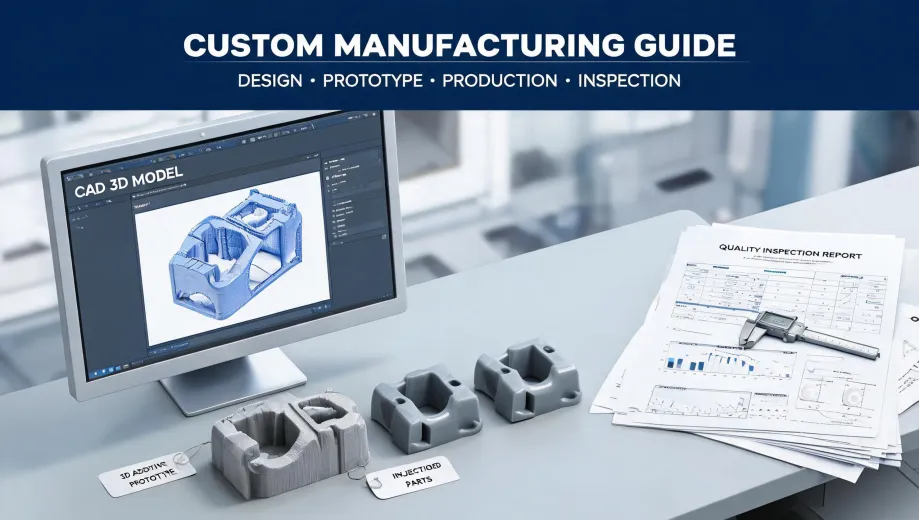
I review parts for a living. Real parts, out of cardboard boxes, with a caliper in one hand and a material certificate in the other. Full disclosure: I'm a quality/compliance manager at a product development firm. Over the past twelve months, I've signed off on 214 custom-fabricated items and rejected 19 of the first deliveries. That's a 9% first-pass reject rate. Honestly, that number used to annoy me. Now I treat it as a useful signal—as long as the supplier catches the problem before I do.
If you're ordering custom parts, you've probably seen Xometry's instant quote button. Maybe you've used the French version, devis instantané fabrication, if you're in France or working with a European manufacturer. The quoting engine is genuinely fast. It gives you a price and a lead time in minutes. But it does not give you a quality plan.
Xometry Receives ISO 9001 and AS9100 Certifications: Why It Matters
When a platform like Xometry receives ISO 9001 and AS9100 certifications, some buyers shrug. I don't think they should. ISO 9001:2015 is the international quality management standard. AS9100D is the aerospace-specific version. Both require documented processes, traceability, auditor oversight, and systems for handling parts that don't meet spec. The reason certifications matter is not because certified companies are perfect. It's because they have a process for catching mistakes before the part ships.
Caveat: a certification applies to a quality management system, not to every individual part. When I first started using digital manufacturing platforms, I assumed a cert badge meant every shop in the network was audited equally. That's not quite true. The certification is only as strong as the weakest link in the chain. So use the badge as a filter, not as a guarantee.
The Real Problem: A Quote Is a Promise, Not a Process
The deeper issue—and the one I wish more buyers understood—is that instant quoting engines are built to answer two questions: how much and when. They are less good at answering the question that decides whether a part works: what exactly are we making?
Take a typical machined bracket. The CAD file looks complete. The quote comes back in minutes. But the details that make or break the part are often not in the file: edge break, surface finish, material grade, thread tolerance, inspection requirements. If those specs are missing, the manufacturer fills the gaps with assumptions. Sometimes the assumptions are fine. Sometimes they're not. That's how you get a part that looks perfect and fails inspection.
Why does this matter? Because an instant quote cannot tell you what you didn't specify. There's a phrase I use with my team: CFC—computer says fine. The file is fine. The quote is fine. The part on a QC bench is not fine. The gap between those two is where problems live.
I don't have hard data on how often missing dimensions cause failures across the whole industry. But based on my own 214-part sample, the biggest source of rejects is not the manufacturer. It's the undefined tolerance.
A Quick Detour: Laser Cutters, Carbon Fiber, and the 'Make Money' Trap
If you're here because you want to make money with a laser cutter, stay with me. A laser cutter can be a profitable tool. It can also be an expensive paperweight. The difference is not the machine. It's the process you build around it.
Take carbon fiber laser engraving. It sounds straightforward—point the beam, mark the surface. But carbon fiber is not wood. The epoxy matrix absorbs a CO2 laser's heat unpredictably, and if your settings are wrong, you get melted resin, exposed fibers, or a part that has to be scrapped. I once watched a small shop in Altamonte Springs run a CO2 laser resurfacing job on a mold. The operator had to change pulse settings completely from what he'd been using on plastic. Laser work is material-specific.
That is a boundary of expertise. A generalist who says 'I can cut anything' is a risk. A specialist who says 'I do carbon fiber engraving, here's my process, and here's my scrap rate' is a vendor. The same line appears in every custom manufacturing conversation.
The Cost of 'Good Enough'
Ignoring these boundaries has a real price. Last year, we received a batch of laser-cut stainless steel shims with a beautiful finish. The material certificate said 301. The spec said 304. The vendor said 'close enough.' Close enough cost us a $22,000 redo and moved our launch back three weeks. The quote had been competitive. The total cost of ownership was not.
The most frustrating part of my job is that this keeps happening, even with certified suppliers. You'd think a written spec would prevent communication gaps. It doesn't. It just reduces them. The remaining gaps need review, testing, and an honest conversation about what someone is actually good at.
What I Do Before Trusting Any Instant Quote
I still use Xometry. I like the speed, the access to different processes, and the way I can get a devis instantané fabrication when I'm working with a French supplier. But I treat the quote as a starting point, not a warranty. Before I click buy, I do four boring things:
- Write the spec down. Material grade, finish, tolerance, inspection requirements. If I can't describe the part in text, I don't order it.
- Ask for a first article on anything involving tight tolerances, carbon fiber laser engraving, or a material that can be silently substituted.
- Ask what the certification covers. If someone says they're AS9100-certified, I ask to see the scope. It tells me whether they're certified for machining, sheet metal, or just for distribution.
- Ask which process they'd recommend. A supplier that says 'this isn't our strength—here's who does it better' earns my trust for everything else. I'd rather work with a specialist who knows limits than a generalist who overpromises.
So use the instant quote. Use the platform. But remember that speed is not the same as clarity. And if you want to make money with a laser cutter, that's the real lesson: make the process your product, not the promise. Standards change, by the way. As of early 2025, the versions I checked against were ISO 9001:2015 and AS9100D. Verify the current revision before you build your quality plan around a badge.