The 48-Hour Rescue: Rubber 3D Printing, CNC Precision, and a Nose Radius Lesson on Xometry
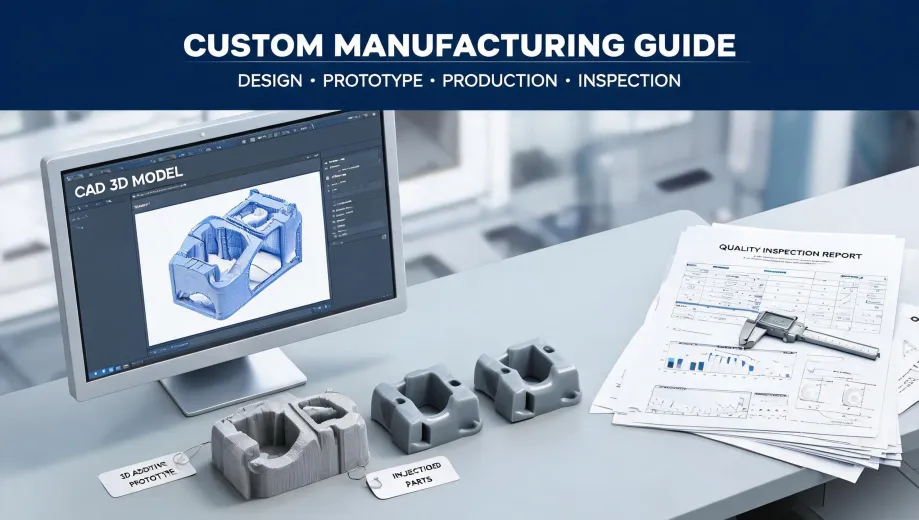
It started on a Thursday evening in early June 2024. I was packing up when my phone rang. The voice belonged to my project lead, and he doesn't call that late unless something is on fire.
The machine shop that normally handled our prototypes had just told him they couldn't finish our order in time for Tuesday's client demo. Not because they didn't care; standard lead times are standard. We needed two custom parts. One was a precision CNC-machined aluminum bracket. The other was a flexible rubber seal. We had maybe four days.
Not ideal. But after coordinating urgent custom parts for a few years, I knew there was always another route.
Option 1: Buy a 3D Printer?
Someone in our group chat suggested we just buy a printer. My project lead, who types faster than he proofreads, texted: how mich are 3d printers?
Honestly, that's a fair question. A basic desktop FDM printer costs somewhere in the $200 to $1,500 range, depending on build volume and quality (based on typical retailer listings in 2024; verify current pricing). But our seal needed to flex like rubber, and the bracket was aluminum. A desktop printer wasn't going to produce either part.
Plus, buying a machine to solve a one-time deadline isn't a no-brainer. The real question wasn't how much are 3D printers. It was how fast we could get reliable parts without owning one. That question led me to Xometry.
A Short Xometry Digital Manufacturing Company Overview
If you are only here for a Xometry digital manufacturing company overview, here is the useful version. According to Xometry (xometry.com), it is an on-demand digital manufacturing platform. You upload a CAD file, choose a process and material, and Xometry's instant quoting engine returns pricing and lead time in minutes. The company connects customers to a network of manufacturing partners that cover CNC machining, 3D printing, injection molding, sheet metal, and more.
That sounds like marketing copy, I know. But in an emergency, it meant I did not have to call five machine shops and read dimensions over the phone. I uploaded the parts, got quotes, and started planning the rest of the weekend.
Two Parts, Two Different Processes
The flexible seal was the part that worried me. It needed a rubber-like feel and had to spring back after compression. A rubber 3D printing service on Xometry made sense for this stage of prototyping. The material list included flexible elastomers with a Shore A hardness near our target. I want to say the quote landed somewhere in the $150 to $250 range, but don't quote me on that; Xometry's system multiplies geometry, material, quantity, and lead time to price each job individually.
Could we have injection molded the seal instead? Not in this timeline. A mold would have taken longer and cost more, unless we wanted to gamble on an unproven quick-turn tool. The rubber 3D printing route was faster and good enough for the review.
For the bracket, I selected precision CNC machining for custom projects. The part had tapped holes and datum surfaces that needed real tolerances. The instant quote gave a lead time that made Tuesday feel possible.
Then the platform sent a design-for-manufacturing warning. And I almost ignored it.
The Nose Radius of Cutting Tool: A Rule That Still Bites
My CAD file for the bracket had a sharp internal corner at the bottom of a pocket. The DFM feedback suggested adding a fillet. Why? Because of the nose radius of cutting tool.
The cutting tools used in CNC machining are not infinitely sharp. They have a radius where the cutting edge meets the work. When a standard end mill cuts an inside pocket corner, that radius becomes the smallest inside corner you can reliably get. You can use a smaller tool or add a secondary operation to reduce it, but the job gets slower and more expensive.
Actually, in milling the exact geometry is usually controlled by an end mill's corner radius, not a lathe tool's nose radius. But in CAD and CAM packages, you will still see references to the nose radius of cutting tool, and the design principle is the same: if you specify a zero-radius internal corner, plan on trouble.
I should add that this wasn't my first encounter with that lesson. In my first engineering job, I approved a part with a sharp internal corner and ignored a manufacturer's DFM note because the CAD model looked fine. The machined part arrived with a visible radius, the mating piece didn't seat, and the redo cost $800 and two extra days. I only believed the rule after I paid for ignoring it.
The fix took a few minutes: increase the internal corner radius to about 0.8 mm. It still looked sharp at a glance, but it gave the cutter room to work. The updated quote came back faster and lower.
Monday Morning: The Quality Test
Monday at 8:14 AM, both boxes arrived. The bracket had clean edges, aligned threads, and a finish that looked like it belonged on a real product. The flexible seal had a matte texture and compressed the way we designed. The prototype snapped together exactly as it did in CAD.
There's something satisfying about that after a weekend of chaos. The client's engineers handled the unit and said, this actually feels solid. They didn't ask about our supply chain drama. They just noticed the quality.
That moment is the part of this story I keep coming back to.
What I Would Tell My Past Self
I have mixed feelings about rush fees and on-demand manufacturing premiums. On one hand, paying extra because time is short feels like a penalty. On the other, rush orders genuinely disrupt production: machines get rescheduled, people work late, and errors happen under pressure. The premium is not imaginary.
What matters is total cost. A cheap quote that arrives after your deadline is more expensive than a reasonable quote that arrives when you need it. For this project, using Xometry's network and its DFM checks was worth every cent.
And if you are still wondering how much 3D printers cost? It depends on what you actually need to make. For occasional rubber-like prototypes and precision CNC parts, owning a printer was not the smart move for us. Uploading files to an on-demand digital manufacturing service got us reliable parts without the capital expense or the learning curve.
Bottom line: output quality becomes your brand image. The client never knew we nearly missed the deadline. They only knew the prototype looked and felt solid. That impression is the real deliverable.