The Cheapest Quote Is the Most Expensive Option: What 5 Years of Manufacturing Orders Taught Me
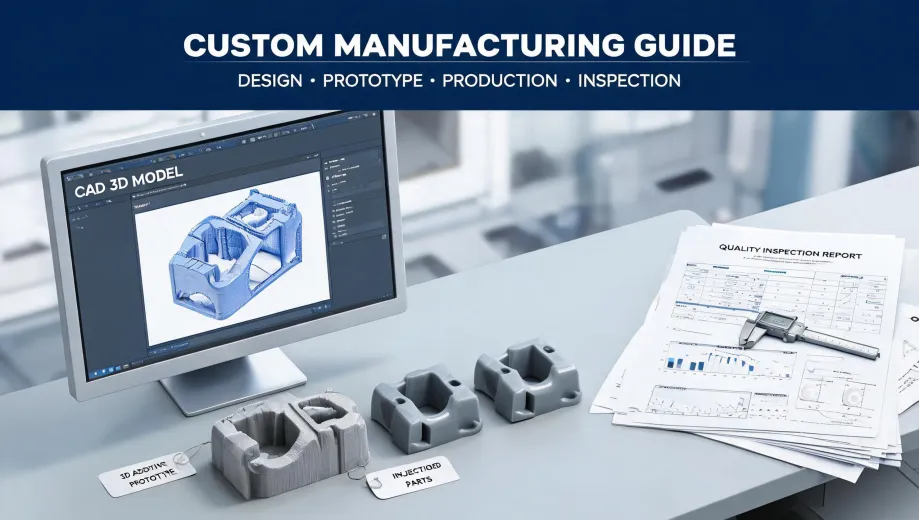
I'm going to say something that sounds wrong at first: the cheapest quote is the most expensive option you can choose.
Let me explain before you close this tab. I'm an office administrator for a 120-person company. I manage all our custom manufacturing orders—CNC machined parts, 3D printed components, sheet metal, injection molded pieces, you name it. That's roughly $180,000 per year across 8 vendors, and I report to both operations and finance. For five years, my job has been balancing what engineers want, what accounting allows, and what vendors actually deliver.
Here's the pattern I've seen up close: most buyers focus on per-unit pricing and completely miss setup fees, revision costs, and shipping that can add 30–50% to the total. The question everyone asks suppliers is "What's your best price?" The question they should ask is "What's included in that price, and when will I actually have the parts in my hands?"
The $190 "savings" that cost us $3,200
Back in 2022, we needed about 200 custom stainless steel fasteners—slotted head, nonstandard thread pitch. One budget vendor quoted $2.60 per unit. Our regular supplier quoted $3.55. I assumed "same specifications" meant identical results across vendors. Didn't verify. Turned out the strictness of their QC was... not the same. Parts arrived three days before the product demo, and they didn't fit. The tolerance interpretation was different. A quarter of the batch was out of spec.
We paid $750 for expedited replacement from the original supplier, $1,150 in engineering rework to adjust the mating parts, and lost about 20 hours of technician labor. Total: around $3,200. The "savings" on the original order was $190. I still wince thinking about it.
So in March 2024, when we needed 60 CNC-machined aluminum brackets for a trade show booth, I did something different. A budget shop quoted $14.80 per part—about 15% below the other three quotes. But lead time was "approximately two weeks." I asked for a guaranteed date. They said they'd "try."
Instead, I put our engineering team's CAD files into Xometry's instant quoting engine. Forty seconds later I had a price—$17.20 per part—with a confirmed 5-day lead time. Material, finish, tolerance, quantity, ship date. All locked in before I ordered. (Should mention: I've used Xometry CNC machining for years, but this was the first job where I specifically chose them for the delivery guarantee rather than the quote.)
The price difference was $144 total. That's about two hours of my time. You know what's not worth $144? Standing at a trade show booth with empty brackets and a story about a vendor who "tried."
The value of guaranteed turnaround isn't the speed—it's the certainty. For event materials, knowing your deadline will be met is often worth more than a lower price with "estimated" delivery.
The numbers said save $144. My gut said the "approximately two weeks" was really a "maybe two weeks." I went with my gut. A few weeks later I learned that same shop was running three weeks behind on orders—they'd been quoting optimistic dates just to land work. Our Xometry brackets arrived on day five, exactly as promised.
What a drone project taught me about 3D printing
Last fall, our engineering team asked for a small batch of custom drone parts—lightweight camera mounts for a product demonstration. One engineer suggested buying a 3D printer and making them ourselves. Specifically, he'd been researching the QIDI Q2C 3D printer, which keeps showing up on "best 3D printers under $700 in 2025" roundups. And honestly? The QIDI Q2C is a genuinely impressive machine for the price. Heated chamber, CoreXY design, solid build volume, strong reviews.
But here's what's easy to miss when you're reading reviews: a 3D printer isn't a manufacturing process. It's a tool that needs tuning, calibration, and iteration. A heated chamber doesn't make the first layer stick. A CoreXY frame doesn't prevent stringing or warping. Getting production-quality parts from a sub-$700 printer takes days of setup and a pile of test prints.
We needed three parts, a specific ABS-like material, and a four-day turnaround. The QIDI Q2C would've needed a week just to arrive, let alone be calibrated. So I uploaded the models to Xometry's 3D printing service. We'd compared Xometry's drone 3D printer options—their platform handles multiple processes and materials, so the engineers found exactly what they wanted. Quote came back at $68 total with a 4-day lead time. Parts arrived on day four, beautifully finished, ready to mount.
I want to be clear: we did end up buying the QIDI Q2C for the engineering lab. It's excellent for prototyping and iteration when the timeline is flexible. But for production parts with a deadline? Send it out. Don't fight with printer settings at 11pm the night before a demo.
"How much is CO2 laser cost?" is the wrong question
Someone from marketing asked me this a few months ago. They'd spotted a desktop CO2 laser cutter online for $499 and wanted to engrave our own promotional materials. "We'd save so much money," they said. It's a familiar conversation.
If you're googling "how much is CO2 laser cost," the short answer is: it depends. A budget 40W unit (the generic K40 style) runs around $450–$600 delivered. But that's not the real number. You also need ventilation—$150–$300. A rotary axis for engraving cylindrical items—$120–$200. A replacement tube and lens—$100–$150, because the stock tube on budget lasers can die within months. A chiller if you want the tube to last—$200–$300. A usable 60W setup from a brand with local support? Plan $2,500–$4,000.
But even that's not the real cost. The real cost is the operator's time. Learning the software, running test cuts on scrap, fixing misaligned optics, re-cutting pieces when the settings burn through. I want to say the marketing person dropped the idea within two weeks, but don't quote me on the exact timeline. What I remember clearly is that nobody volunteered to be the operator.
Same logic applies to manufacturing quotes. The lowest number on the invoice is not the lowest total cost. Machine, accessories, consumables, training, rework, missed deadlines—that's the real price.
"But I can't afford the premium"
I hear this a lot, and I used to say it myself. But here's the thing about Xometry: it's a marketplace. Hundreds of partner shops compete for work through the platform, and the instant quote is often genuinely competitive. I've had multiple orders where Xometry's price was the lowest I received. When it's not the lowest, the delta is typically a few percent—not the 30–50% gap people imagine.
Another objection: "What about relationships with local suppliers?" Look, I still use two local shops for jobs they're best at. Relationships matter. But local shops have capacity limits, material sourcing issues, and their own backlogs. When I need a confirmed delivery date across multiple processes—CNC, sheet metal, 3D printing, injection molding—a platform like Xometry gives me consistent pricing and confirmed dates in minutes. It's not either/or. It's both.
Now, I'm not saying every order needs rush delivery. It doesn't. Flexible timelines are exactly when you can afford to take a chance on a cheaper source. But make that decision consciously. Don't default to the lowest quote out of habit, then act surprised when the date slips.
Bottom line
Five years in this role taught me one lasting lesson: in custom manufacturing, you're not paying extra for speed. You're paying extra for certainty. A confirmed delivery date isn't a luxury. It's a risk management tool.
The budget vendor with the handwritten invoice. The "approximately two weeks" promise. The $499 laser that needed $800 in accessories and three weeks of troubleshooting. They all taught me the same lesson: the cheapest quote is only the cheapest if everything goes right. And "if everything goes right" is not a strategy.
So next time you're comparing quotes, ask two questions. "What's your best price?" and "What's your guaranteed delivery date—and what happens if you miss it?" That second question is where the real cost lives.