The Hidden Cost of Custom Parts: Xometry Instant Quote, Laser Welding Wavelength, and VMC Specs
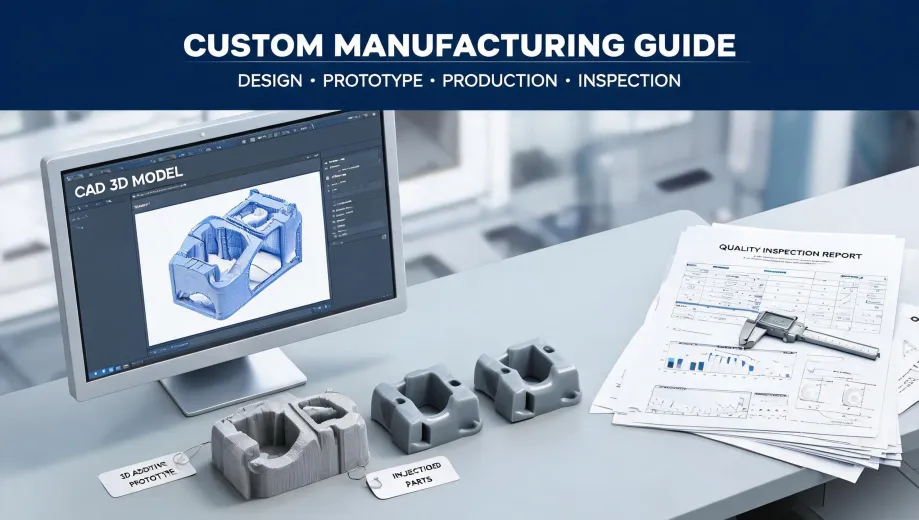
The $340 bracket that took 11 days
Last March, I spent 11 days trying to buy a $340 bracket. Not a typo. I'm the office administrator for a 120-person engineering firm. I manage all custom manufacturing ordering—roughly $180,000 annually across 11 vendors. I report to both operations and finance.
On paper, my job is simple: get the part, get the invoice, close the PO. In reality, custom parts are a mess of CAD files, half-specified materials, and vendors who all want something different before they'll quote. The bracket was supposed to be a two-day job. It became a two-week lesson in why procurement stalls.
The surface problem: quotes take forever
When I took over purchasing in 2020, I thought the problem was speed. I'd send a drawing to a machine shop, wait three days, and get a quote back with a note: 'Need more info.' I'd send the note to engineering. They'd reply with a one-line answer. I'd forward it. Then the vendor would ask another question. Another day gone.
After five years of managing these relationships, I can tell you: the quote itself isn't the bottleneck. The bottleneck is everything before the quote.
What I thought was happening
I thought vendors were slow. I thought engineers were disorganized. I thought if I just emailed harder, things would move faster. Wrong, wrong, wrong.
What was actually happening
The engineers knew exactly what they needed. They just used a language I didn't speak. Terms like laser welding wavelength, flat bottom reamer, and VMC flew across my inbox. I nodded for months. Then I started asking questions. That's when the real delays showed up.
The deeper problem: nobody speaks the same language
Take laser welding wavelength. Fiber lasers commonly run at 1064 nm; CO2 lasers run at 10.6 µm. That difference changes which materials weld cleanly. If the drawing says 'laser weld' but not which wavelength, the vendor might quote the wrong process. Then we get a price, approve it, and find out three days later it's not right. Back to square one.
Fiber laser welding commonly uses 1064 nm; CO2 lasers use 10.6 µm. That difference matters for material compatibility, especially with reflective metals (Source: Laser Institute of America, Laser Welding Fundamentals; verify with your vendor).
Take a flat bottom reamer. It's not a standard reamer. It cuts a flat-bottomed hole, often for a socket head cap screw or a dowel pin. I once found a flat bottom reamer supplier southeast Michigan through a distributor. Great price. But the lead time was 4 days just for the quote, and their minimum order was $600. Our engineer needed one reamer. We didn't need a $600 relationship. We needed a hole.
And yes, I had to Google what does vmc drink stand for after a machinist wrote 'VMC drink stand' on a request. In a machine shop, VMC usually means vertical machining center. Not a beverage. Not a stand. Just a mill that cuts metal on three axes. I felt dumb for 10 minutes, then I realized this is exactly the kind of gap that kills procurement speed.
The cost isn't just the quote delay
Every clarification adds a day. Maybe two. We process 60–80 orders annually. If each order needs two extra clarification loops, that's 120–160 hours of back-and-forth. That's not just my time. It's engineering time. It's finance time. It's project delay.
I still kick myself for not documenting a vendor's verbal promise on a rush order in 2022. They said they'd waive the expedite fee if we hit a certain quantity. We hit it. They charged us anyway. Without written confirmation, finance rejected the $2,400 expense. That came out of my department budget. Now I verify invoicing capability before placing any order—especially with new suppliers.
There's also the quality perception problem. If a bracket looks rough, the client notices. If a replacement part doesn't fit, the field tech notices. If an internal prototype looks like a high school shop project, the whole engineering team looks bad. Quality is brand. The $50 difference per project can translate to noticeably better client retention, but only if you spend it in the right place.
Why this keeps happening
The root cause is fragmentation. A single custom part might need CNC machining, laser welding, a reamer, and a finish. Each step lives with a different vendor. Each vendor has its own quote form, lead time, minimum order, and invoice process. There's no shared language.
Meanwhile, engineers use terms like VMC, laser welding wavelength, and flat bottom reamer as if everyone knows them. They're not trying to be obscure. They're just speaking their native language. But I'm an admin buyer, not a machinist. I need a translation layer.
Finance needs clean invoices. Operations needs on-time delivery. Engineering needs the right spec. The vendor needs a complete package. When any of those pieces is missing, the order stalls. And the person caught in the middle is usually me.
What I changed (and where Xometry fits)
I didn't find a magic fix. I found a shorter path for some jobs.
We started using Xometry for standard CNC, sheet metal, and some 3D printing. The Xometry instant quote engine is the part that actually changed my week. I upload a CAD file, pick a process and material, and get a real price in minutes—not days. It's not always the cheapest. It's not always the right fit for every job. But it gives me a baseline I can take to finance without waiting on three voicemails.
We tried metal 3D printing through their platform after I read Xometry metal 3D printer reviews. The reviews were mixed on surface finish, which matched our experience: good for internal brackets, not for customer-facing parts without post-processing. That's fine. I'd rather know the trade-off upfront than discover it after a week of email.
For a flat bottom reamer supplier southeast Michigan, I still keep a local shop in the loop. High-touch jobs need a human. For laser welding, I now ask for the wavelength and material before I send a quote request. For VMC work, I ask for tolerances and any special tooling. Xometry handles the fast quote; I handle the spec check.
The honest caveat
This worked for us, but our situation was a mid-size B2B company with predictable ordering patterns. Your mileage may vary if you're a seasonal business with demand spikes, or if you need exotic materials and tight tolerances on every job. I can only speak to domestic operations and standard prototyping. If you're dealing with international logistics, there are probably factors I'm not aware of.
I have mixed feelings about moving more ordering to a platform. On one hand, it's faster and finance loves the clean invoicing. On the other, I miss the relationships with local shops. Part of me wants to consolidate to one vendor for simplicity. Another part knows that redundancy saved us during the 2021 supply chain mess. We compromise with a primary + backup system: Xometry for instant quotes and standard parts, local suppliers for complex, high-touch work.
The bottom line
Custom part procurement doesn't stall because people are lazy. It stalls because the information is fragmented, the language is technical, and the cost of clarification is hidden. Once I started treating specs—laser welding wavelength, reamer geometry, VMC tolerances—as part of my job instead of someone else's, the delays dropped. Xometry's instant quote didn't solve everything, but it cut the worst part: waiting four days for a number I could have had in four minutes.
Prices and lead times as of May 2024; verify current rates. And if you're still wondering what VMC stands for, it's vertical machining center. Not a drink. Trust me, I checked.