When My Brake Pedal Squeaked, I Tried Xometry On-Demand Manufacturing—and Learned the Real Difference from DIY
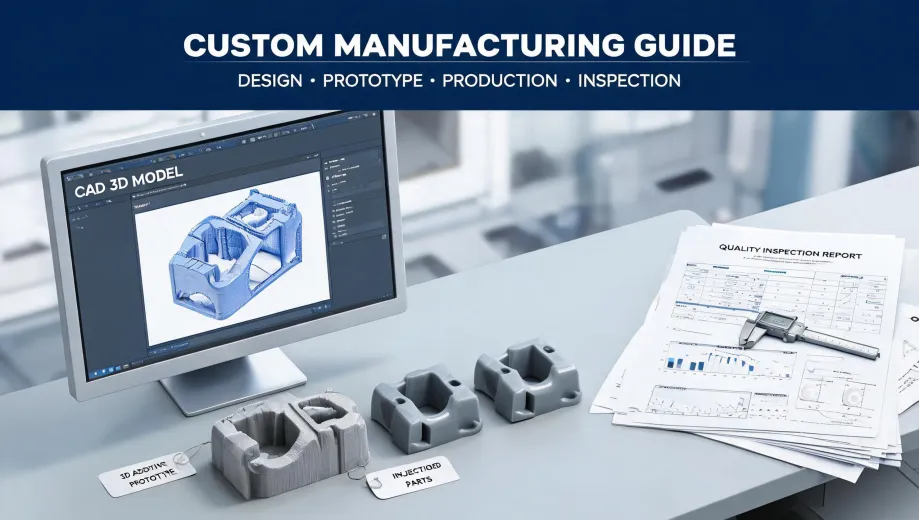
Let me start with a confession: my brake pedal squeaks when I press it. Not the decorative kind of squeak. The kind that slowly eats your sanity during rush hour. I traced it to a small plastic bushing in the brake light switch bracket—worn out after a decade of city driving. No dealer sells that bushing separately. So there I was, Friday night, staring at a worn piece of plastic and two very different paths: try to make it myself, or hand the CAD file to a service like Xometry's on-demand manufacturing platform.
I've been designing parts for about six years now, and I still keep a list of my own screwups pinned above my desk. The last significant one cost me $890 in wasted material and a week of delays. That list is exactly why I decided to test both approaches. Here's what the comparison taught me.
The Setup: What We're Actually Comparing
On one side, Xometry. It's an online platform that gives you an instant quote, connects you to a network of factories, and ships you a finished part. On the other side, the DIY route: me with a rotary tool, a sheet of polycarbonate, and a borrowed laser cutter. The question wasn't which is easier—it was which actually delivers a part you can trust.
Comparison 1: Design Workflow vs. Wing-and-a-Prayer
With Xometry, you upload your 3D model, pick a material and process, and the quoting engine spits out pricing and lead times before you finish your coffee. If a feature is too thin for CNC machining, it tells you before you waste money. That alone saved me from a design that would've snapped in week two.
My DIY workflow was less elegant. I measured the bushing with calipers, sketched it in my head, and reached for the polycarbonate. I assumed a simple rectangle would be fine. It wasn't. The first cut, the laser cutter left scorched edges and a faint burnt smell that I later learned is polycarbonate breaking down under heat. I didn't verify the chemical compatibility. I just went with it.
Let me rephrase: I knew laser cutting polycarbonate is usually a bad idea, but I thought 'what are the odds?' Well, the odds caught up with me when the edges turned brittle and discolored.
Comparison 2: Material Options vs. What's Lying Around
Xometry's real strength isn't just speed—it's the range. For this bushing, I could've picked acetal, PTFE, or even an aluminum version if I wanted to over-engineer it. The platform handles CNC machining, 3D printing, injection molding, sheet metal—you name it. That flexibility means you pick the right material for the application, not whatever happens to be in your garage.
My garage offered polycarbonate and hope. Neither was the right call for a bushing that needs to resist moisture and abrasion. But the real DIY disaster came when I tried to swap out the cutting wheel on my rotary tool to shape the piece. I didn't get the arbor tightened properly, and the wheel wobbled. If you've ever wondered how to attach cutting wheel to rotary tool correctly—the answer is to make sure the threaded shaft engages fully before locking it down. I skipped that step, and the wheel shattered on the first pass. No injury, but a $12 accessory gone and a piece of polycarbonate that resembled a melted toy.
That's the contrast: one platform gives you a validated menu of materials, a clear line to a manufacturing process, and a part that matches the spec. The other gives you a few hours of frustrated YouTube tutorials and a burned smell in your workspace.
Comparison 3: Quality Consistency vs. The Squeak Reappears
After my DIY attempts failed, I ordered the part from Xometry. The instant quote was $14.27 for a small acetal bushing, plus shipping. Three days later, I had a part that fit perfectly. No flash, no warp, no drama.
Here's the thing about quality—it's not just about whether it works. It's about whether it keeps working without nagging you. My brake pedal squeak came back after a week with the DIY version because the scorched polycarbonate wore unevenly. The Xometry part has been silent for four months now. That squeak was a constant reminder of a bad decision. The professional part is invisible, which is exactly what quality should be.
That lesson transfers beyond brake pedals. When you're producing something for your own business or your own customers, the first moment they hold it or use it, they absorb a signal. If it feels cheap, if it squeaks, if it burns—that's what they remember. I've watched clients ignore a $3,200 order with a 10% defect rate, but complain forever about the one piece that broke in front of their customer. Quality perception isn't the whole story, but it's a bigger part than most engineering budgets admit.
When Xometry Wins (and When It Doesn't)
If I'm being honest, the DIY route isn't always wrong. If you need a proof-of-concept prototype in an hour and you're okay with it living on a shelf, a rotary tool and some scrap plastic might do the job. At least, that's been my experience with non-critical geometry. And if you truly need same-day in-hand parts, a local machine shop may beat any online platform.
But for anything that faces load, weather, or human touch—use a service like Xometry. The total cost isn't just the part price. It's your time, the failed attempts, the destroyed cutting wheels, the late nights. When I compared the actual cost of my DIY fiasco (materials, broken bits, lost weekend) to a $14 part, the platform felt almost embarrassingly cheap.
If you're still deciding, ask yourself one question: what is the price of the squeak that won't go away?