Why ‘Pick a Service, Get a Part’ Is a Lie: The Real Cost of Manufacturing Confusion
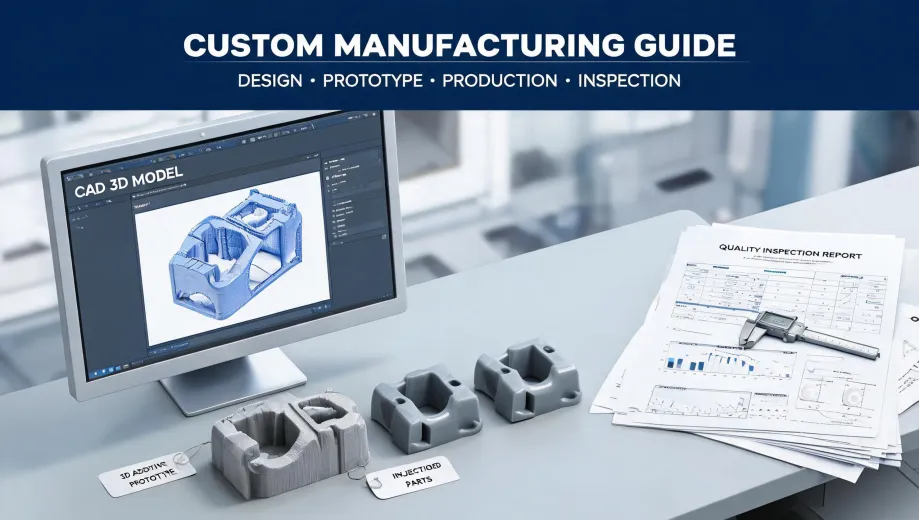
I've been there. You have a prototype that needs to look and function like the final product, and you're staring at a screen with a dozen different manufacturing options. CNC machining, 3D printing, injection molding – it's a lot. So you pick the one that seems to match your vague description: 'I need a rubber part, so I'll use rubber 3D printing service on Xometry.' Makes sense, right?
Wrong. That's the kind of assumption that might cost you.
I've spent the last 6 years managing rapid prototyping and low-volume production for a medical device startup. I've processed more than 200 rush orders, many of which were born from the same root cause: a bad assumption about how a manufacturing process actually works. And the biggest culprit is looking for a service that's named after your material or your part, not your problem.
The Surface Problem: ‘I Just Need a Part’
At first glance, this seems like a simple buying decision. You need a custom part. You go to a platform (like Xometry) that can make it. You pick a process. You get your part. That's the promise of this whole 'instant quoting engine' revolution. And to be fair, it's a huge step forward.
But the on-demand manufacturing model hides a dangerous trap: process selection is not just a transaction; it's a design decision.
I remember a call from a client in March 2024. They needed a rubber gasket for a prototype. They had seen 'rubber 3D printing service on Xometry' and thought, 'Perfect. That's what I need.' The quote came back at $250 for a single part, with a 3-day lead time. They were happy. They placed the order. Forty-eight hours later, they called me in a panic.
The part had arrived, and it looked nothing like what they expected. It was rigid, had a terrible surface finish, and wasn't even close to being functional as a seal. They had assumed 'rubber 3D printing' meant a final, flexible rubber part. They didn't know that most 'rubber-like' materials (like TPU) on standard 3D printers are a far cry from thermoset rubber, or that the finish would require post-processing. Their assumption was that the service name perfectly described the outcome. It didn't.
The Real Problem: The ‘Service’ Name Hides the Complexity
This is where the 'problem deep dive' starts. The surface issue was a bad part. The deeper issue is that the ecosystem of on-demand manufacturing platforms has inadvertently created a false equivalency between the name of a service and the engineering reality of a part.
When you look at a platform like Xometry, you see a vast catalog of services: 'gas assist injection molding service at Xometry', 'laser tube cutting Prescott', 'CNC machining', 'sheet metal fabrication'. They look like items on a menu. You pick what you think you need. But a menu implies a simple, predictable outcome. Manufacturing isn't that simple.
Take 'gas assist injection molding service at Xometry'. This is a highly specific, advanced process used to create large, hollow, or structurally demanding parts while saving material and cycle time. If you're a beginner or not an engineer, you might see 'injection molding' and assume it's for a simple plastic part. You might miss the fact that it's a specialized process that requires robust tooling and is best for specific geometry types.
Or consider 'laser tube cutting Prescott'. That's a service in a specific location (Prescott, AZ?), but it's just one variable in a larger equation. What's the wall thickness? What's the material (aluminum, steel, stainless)? What's the tolerance? What's the cutting gas? A simple laser quote is different from a complex 45-degree miter cut on a heavy structural tube. The platform's algorithm might give you a price, but it can't read your mind.
The Price of Confusion: Time, Money, and Missed Deadlines
The real-world cost of this 'pick a service' mindset isn't just a few hundred dollars on a bad quote. It's the cascading failure of a project timeline. It's the vendor who can't deliver because they interpreted your request differently.
I once managed a project that needed a 'custom ball mill material inlet end cover'. It's a heavy, complex, cylindrical part for a mining application. We had a quote from a traditional machine shop, but we thought we could save money by going through an on-demand platform. We selected 'CNC machining' as the service, assuming it was a simple turning job. We got a quote, placed the order, and the part came back wrong. The inner taper was off by 0.5 degrees. Why? Because we hadn't selected '5-axis CNC machining' or specified the correct post-processor. The platform's algorithm, optimized for 'simple CNC', assumed a lower complexity level.
Looking back, I should have paid the premium for the traditional shop that understood the application. At the time, the $300 savings from going through the platform seemed like a win. It wasn't. The re-work cost $1,200 and delayed the project by two weeks.
This is the hidden tax of using a 'menu' to solve a complex engineering problem. You save money on the first quote, but you pay for it in the second, third, and fourth failed attempts.
The Real Solution: Stop Asking ‘Which Service’, Start Asking ‘What is My Problem?’
So, what's the answer? It's not to avoid platforms like Xometry. They're powerful. The answer is to change your approach entirely. Don't ask 'which service do I buy?' Ask 'what is the critical function of my part, and what process is best suited to deliver that function?'
If you need a custom ball mill inlet end cover, don't just pick 'CNC machining'. Call the vendor, or use the platform's expert support. Explain that you need a heavy-duty, precision-machined part with a specific taper. The algorithm might then route you to a '5-axis CNC machining' service or a 'multi-axis turning' service with a higher price, but a much higher probability of success.
If you need a rubber part, don't simply look at 'rubber 3D printing service on Xometry'. First, ask: do I need the look and feel of rubber for a prototype, or do I need a functional, long-lasting seal? If it's the latter, you likely need a resin that mimics rubber, or you should go straight to injection molding, which will be more expensive but will deliver the exact material properties. If it's just for looks, the 3D printed TPU might work, but you must accept its limitations.
The most successful projects I've seen on these platforms start with a deep, honest conversation. The engineer doesn't just click 'instant quote'. They use the platform to find a partner, not a vending machine. They leverage the platform's knowledge base, ask for design for manufacturability (DFM) feedback, and accept that the 'quickest' quote might not be the best quote.
An informed customer doesn't just get a better price. They get a better outcome. They stop being a 'box-checking' buyer and become a partner in the manufacturing process. That's the real value of a platform like Xometry... but only if you stop treating it like a vending machine and start using it as a bridge to engineering knowledge.
[Pricing for general reference only. Actual manufacturing costs vary based on material, complexity, quantity, and lead time. As of May 2025.]