Why Small Orders Feel Punished—and What a Xometry Manufacturing Marketplace Changes
I manage purchasing for a 19-person engineering services company. In practice, that means I buy everything from printer toner and safety gloves to custom aluminum brackets and injection-molded test parts. It comes to roughly $180,000 a year across 40 or so vendors. I report to both operations and finance, so I see the whole lifecycle: the part has to work, and the invoice has to be audit-proof.
When I first took over purchasing in 2020, I noticed a frustrating pattern. If I asked a local machine shop for a quote on 200 parts, I usually heard back within a day. If I asked for four parts, I often heard nothing at all. My early conclusion was simple: they do not want small customers.
That conclusion was half true. They did not want the small order, but the reason was not just my company's size. It was cost structure. Once I understood the difference, almost every buying decision changed.
The real reason small orders go to the bottom of the pile
It's tempting to think the answer is 'suppliers only care about big money.' That over-simplification ignores a basic operational fact: a custom quote costs the supplier real time before it produces any revenue. An engineer or estimator still has to review the part drawing, choose a process, think through tolerances, source material, confirm finishes, and write the quote. Whether the quantity is one part or ten thousand, a good chunk of that work is identical.
I heard this from a shop manager after one quote request disappeared for two weeks. He wasn't rude. He explained that his estimators were spending 45 minutes on small orders that closed maybe ten percent of the time. The math did not work unless the order was big enough or the process was automated. That conversation changed how I interpreted slow responses. It is not always arrogance. Sometimes it is an operational limit.
There is also a capacity problem. A machine shop's production hours are finite. A $300 order that uses one machine hour may be less attractive than a $30,000 order that uses the same hour. That is not supplier greed; it is just how manufacturing capacity gets allocated. The real issue is that smaller buyers get forced into leftover capacity, and leftover capacity is unpredictable.
What bad treatment actually costs the buyer
The obvious cost is time. If you wait two weeks for a quote that never comes, your own project schedule slips. But the bigger hidden cost is what happens next: buyers start working around the system.
I remember a 2021 project that needed a small test run of aluminum parts. I did not want to wait for another vendor that would not answer, so I bought one similar part with my personal credit card from a consumer site. It arrived quickly. Finance had no record. Engineering was not sure about material. When we later ordered 200 parts, we found the supplier could not provide traceability certificates, and two parts failed in testing. I saved maybe $47 on the trial part and lost ten days of project time. My mistake was not checking the supplier; it was choosing a path that made checking impossible.
Procurement professionals call this shadow procurement, and it terrifies accounting teams. If a part bypasses normal purchase orders, tax registration, and material documentation, the company cannot defend the purchase in an audit. It also teaches suppliers that silence is acceptable, because the buyer will eventually find a workaround.
Price is not the only damage. One supplier once gave us a price that was $200 lower than our regular vendor for a batch of parts. The parts were fine, but the only document he could provide was a handwritten receipt. Finance rejected the expense because it did not meet tax documentation requirements. The department ended up eating the full $2,400 order. That was 2022, and I still check invoicing capability before I place any order.
The same doubt shows up in unexpected categories
If you have never bought custom parts, this might sound like a niche problem. But I see the same theme in almost every unfamiliar purchase I review. Search for a ccmt insert tool holder, for example, and you will see listings that all look similar. The real difference is not the photo; it is the insert geometry, grade, coating, and manufacturer traceability. A supplier that cannot explain those details is not a real supplier; it is a middleman with a web page.
Something similar happens with any equipment purchase. When someone in our office asks about putting in a 3D printer, my first question is blunt: Do 3D printers produce toxic fumes? The honest answer is: it depends. It depends on the resin or filament, the print temperature, the room ventilation, and the manufacturer's safety data. A useful supplier will give you those details instead of a slogan. I cannot speak to every printer chemistry, because I am not an industrial hygienist. But I do know that a supplier who avoids safety documentation is a red flag.
I also had to qualify a vendor offering an endolift laser fiber treatment for a workplace wellness initiative. I am not a clinician, so I cannot evaluate whether the procedure works. But the vendor's proposal had no user manual, no laser safety information, no evidence of training, and no substantiation for its claims. I did not need to be a clinician to recognize a procurement problem. The proposal was all marketing and no documentation.
Per FTC guidance at ftc.gov, advertising claims have to be truthful, not misleading, and backed by evidence. That applies to custom parts too. When a shop says a part will meet a certain tolerance or material grade, I want that claim written in the quote.
What I actually look for in a manufacturing partner
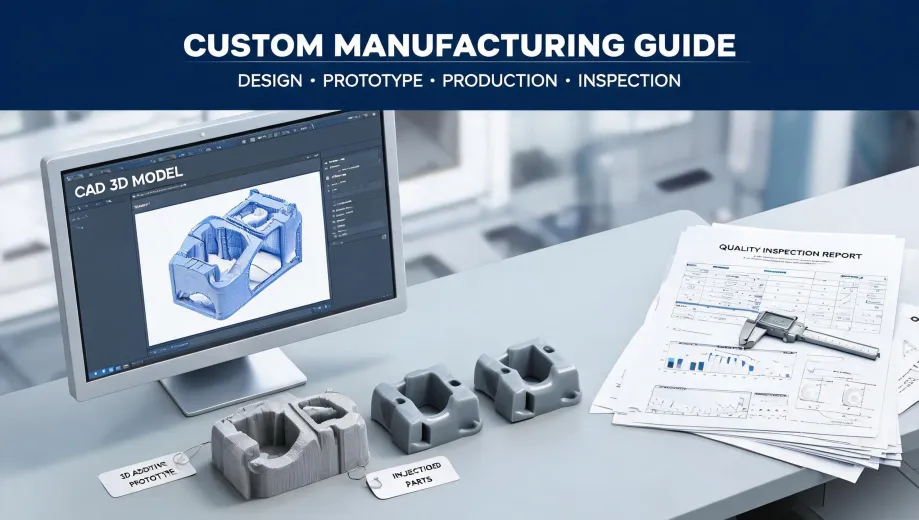
After five years of buying parts for a small company, I stopped looking for a supplier who apologizes for being busy. I look for a process that is built for small orders from the start. That is why, when I need a one-off bracket or a short run of parts, I will often use the Xometry on-demand manufacturing marketplace. It is a Xometry manufacturing marketplace rather than a single local shop, and the quote process is transparent from the beginning.
I do not want to overstate it. Xometry is not magic. Parts can still be wrong, lead times can move, and every buyer should review drawings before ordering. But the platform solves the specific problem that burned me for years: it does not make a small buyer wait ten days just to find out if a job is worth quoting. The instant quoting engine gives a real price, lead time, and material options. If the order is too expensive, I see it early and adjust the design. If I need a certificate, I can ask for it through the system.
I also apply a simple checklist to every supplier, including Xometry:
- Ask for an itemized quote with all fees, including tax and shipping.
- Ask for a W-9 or company EIN before payment, so finance can process the invoice.
- Ask for documentation: material certificates, safety data sheets, regulatory claims, and export information.
- Ask what will happen if the part fails. The answer should be a process, not a promise.
That last point matters. A vendor can be friendly and still fail. A vendor can be quiet and still deliver. What I need is a system that makes both success and failure visible. That visibility is the real advantage of an on-demand manufacturing platform: it turns a request for four small parts into a traceable order, not a favor.
Small orders are not the problem. There is a reason companies order prototypes and small test batches. There is a reason a maintenance department needs a spare part quickly. And there is a reason a $200 first order often grows into a $20,000 production order. The issue is not that buyers want cheap; the issue is that suppliers treat small needs as inconvenient.
You cannot fix that by trying to be more patient. You fix it by choosing partners whose process is built for the order you need today, then verifying that the paperwork, safety data, and invoicing are part of the deal. When the process is right, even a four-part order can feel completely normal.